
Improving Your Pistol Grip for Better Control and Accuracy
A solid pistol grip is essential for managing recoil, improving accuracy, and maintaining control during rapid fire. While grip techniques may vary between shooters, understanding the principles behind an effective grip can dramatically improve your shooting performance. This guide will help you build a grip that keeps your shots tight and your gun steady.
01. Establishing a Strong Dominant Hand Grip
Your dominant hand sets the foundation for controlling recoil. Position the gun as low in your hand as possible while keeping the webbing between your thumb and index finger high on the beavertail. This reduces muzzle rise and helps the gun settle back into alignment after each shot.
A key detail is the pressure applied by your middle finger against the trigger guard. This contact point anchors your grip and provides consistency when drawing and firing. The rest of your fingers should wrap tightly around the grip without leaving gaps. Maintain firm pressure to stabilize the gun without compromising trigger control.
Some instructors recommend loosening the grip to keep the trigger finger relaxed, but applying firm pressure with both hands simplifies recoil management and enhances consistency, especially during rapid fire.
02. Maximizing Control with Your Support Hand
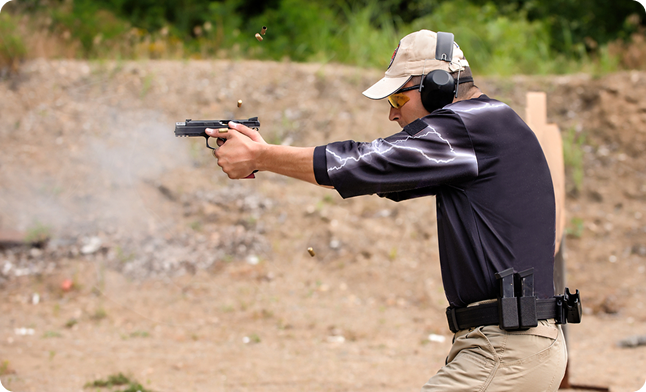
Your support hand plays a critical role in stabilizing the gun and managing recoil. Place the index finger of your support hand under the trigger guard, then roll your hand inward to fill the space on the grip’s side. Your fingers should press firmly under the knuckles of your dominant hand, while your palm makes full contact with the grip.
Apply even pressure with both hands to create a secure hold. The dominant hand presses from one corner of the grip to the other, while the support hand applies pressure in the opposite direction. This creates a strong hold that minimizes muzzle flip and lateral movement during recoil.
Focus on key pressure points in your support hand, especially the palm and the lower knuckle of the thumb. These areas help control the gun’s rotation and ensure quick sight recovery between shots. Avoid resting your thumb on the frame, as it reduces the torque needed to stabilize the gun.
03. Wrist Stiffness and Recoil Management
Even with a solid grip, loose wrists will allow the gun to move excessively during recoil. Stiffening your wrists locks the gun into position and helps it return to the same point of aim after each shot. This involves creating tension through your wrists and forearms to keep the gun steady.
You can practice this with an unloaded gun. Build your grip and apply light pressure to the slide with your other hand to simulate recoil. If your wrists are loose, the gun will dip or shift. When your wrists are properly engaged, the gun will remain steady. Developing this muscle control is essential for consistent shooting and can be refined through focused practice.
04. Avoiding Common Grip Mistakes
Several common mistakes can affect your grip and shooting accuracy. One frequent issue is locking your elbows completely straight. While your arms should be extended, locking your elbows shifts recoil control to your joints instead of your muscles. Keep your arms straight but slightly relaxed to allow your muscles to absorb recoil effectively.
Another mistake is overthinking thumb placement. Some shooters press their thumbs into the frame, but this reduces wrist tension and disrupts stability. Focus on applying pressure through your palms and the lower part of your thumbs, allowing the thumbs to rest naturally.
Neglecting upper body tension can also lead to inconsistent shooting. Engage your shoulders and lats to create a stable shooting platform. Pull your shoulders down and back to maintain control, ensuring that the gun returns to the same point of aim after each shot.
05. Testing and Refining Your Grip.
Experiment with different shooting speeds to test how well your grip holds under rapid fire. A solid grip should allow you to maintain control and accuracy even when shooting quickly. Pay attention to how the gun moves during recoil and adjust your grip and wrist tension as needed.
- Safe Disposal Methods: Contact local law enforcement or a shooting range to learn about disposal programs. Some recycling centers also accept ammunition.
- Handling Misfires: If a round fails to fire, keep the firearm pointed in a safe direction for at least 30 seconds before safely ejecting the cartridge.
Never attempt to dismantle or burn old ammunition as it can be highly dangerous.
05. Final Thoughts
A proper pistol grip is the foundation of accurate, controlled shooting. By focusing on consistent hand placement, engaging your wrists, and maintaining upper body stability, you can significantly improve your recoil management and shooting accuracy. Regular practice and attention to detail will help you develop a grip that keeps your shots tight and your gun steady, no matter the shooting conditions.

